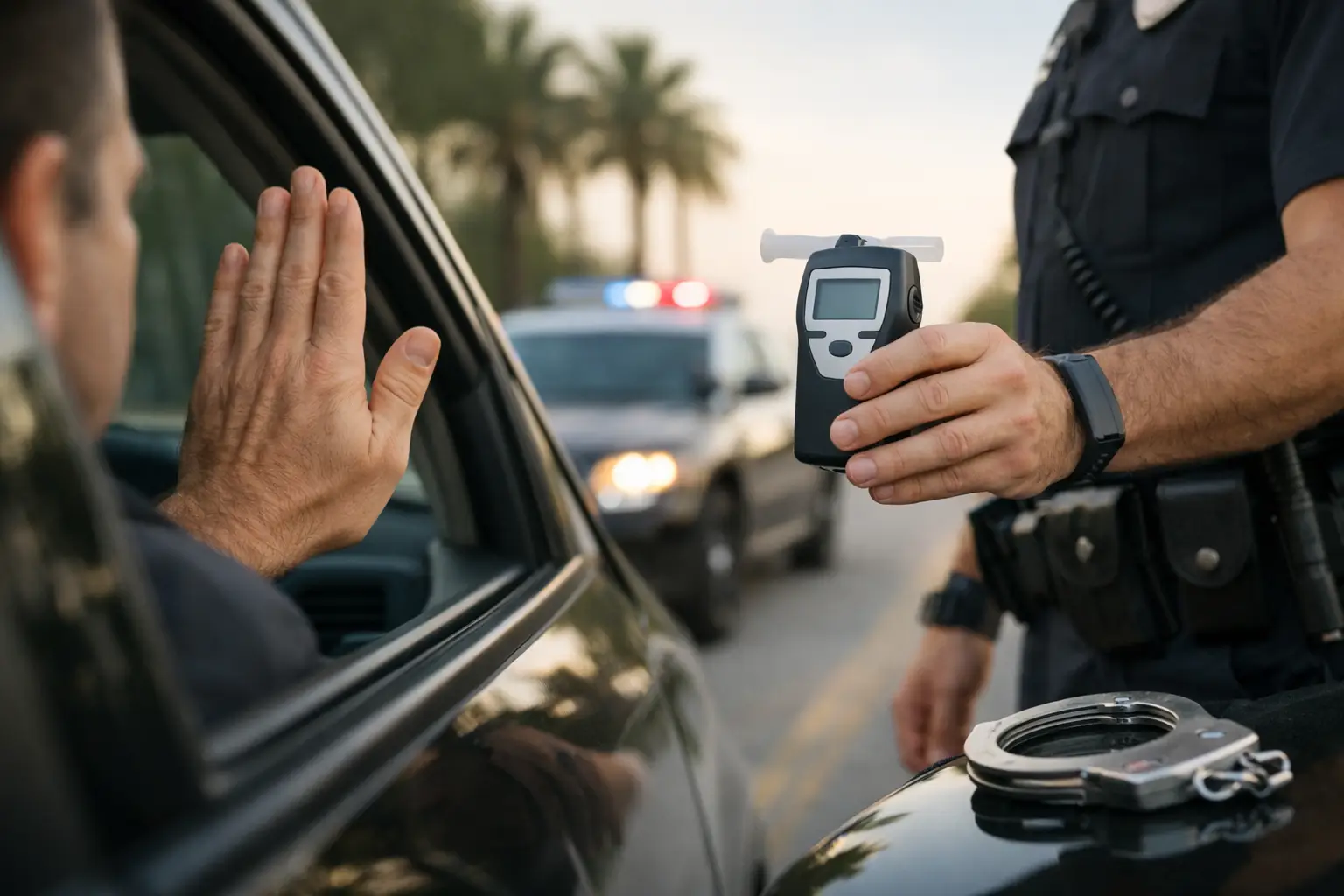
A DUI stop can turn into a second crisis the moment an officer asks for a breath sample. Refused breath test consequences in Florida are immediate, serious, and often misunderstood. Many drivers think refusal automatically helps their case. Others assume it guarantees conviction. Neither is always true. What matters now is what happened during the stop, what the officer said, whether the warning was legally sufficient, and how fast you move to protect your license and your defense.
What happens if you refuse a breath test in Florida?
Florida’s implied consent law says that by driving, you have already agreed to submit to a lawful breath, blood, or urine test in certain DUI investigations. If you refuse a breath test after a lawful DUI arrest, the state can punish that refusal even before your criminal case is resolved.
For a first refusal, your driver’s license can be suspended for one year. For a second or subsequent refusal, the suspension can increase to 18 months, and the refusal may also be charged as a separate misdemeanor. That means one decision during a late-night traffic stop can create both administrative penalties and new criminal exposure.
This is where people get blindsided. They focus only on the DUI charge and miss the separate license case moving on a much shorter timeline. In Miami-Dade, that delay can cost you your ability to drive to work, pick up your children, or keep a professional license in good standing.
Refused breath test consequences go beyond the roadside
The immediate issue is your license, but the fallout can spread further. A refusal can be used by prosecutors as evidence of consciousness of guilt. In plain terms, they may argue you refused because you believed you were over the legal limit. That does not mean they automatically win. It does mean your defense has to be strategic from the start.
Insurance consequences can follow. Employment problems can follow too, especially if you drive for work or hold a position that requires a clean record. For licensed professionals, any DUI-related case can trigger reporting concerns and reputational damage. For repeat offenders, the risk is even higher because prosecutors, judges, and the DMV will look at the history and push harder.
At the same time, refusal is not always a prosecution advantage. If there is no breath number, the state has lost one piece of evidence it often relies on heavily. That can create real defense opportunities, especially when the stop, arrest, field sobriety exercises, body camera footage, and implied consent warning are weak or inconsistent.
The license suspension process moves fast
After a DUI arrest involving a refusal, there is usually a very short window to challenge the administrative suspension. This is one of the most dangerous parts of the case because people wait, assume the court date controls everything, and miss the deadline to fight for their driving privileges.
That mistake is expensive. Once the deadline passes, your options narrow. You may still be able to pursue hardship relief in some situations, but that is not the same as aggressively challenging the suspension from the beginning. If keeping your license matters to your job, your family, or your daily life, speed matters.
This is why immediate legal review is critical. An attorney can examine whether the stop was lawful, whether there was probable cause for arrest, whether the refusal was clear and voluntary, and whether the officer properly advised you of the consequences. If any part of that chain breaks, the suspension and parts of the criminal case may be vulnerable.
When a refusal can become a criminal charge
A first refusal is generally an administrative issue tied to your license. A second or later refusal is far more dangerous. In Florida, it can be prosecuted as a separate misdemeanor. That means you are no longer dealing only with a DUI allegation. You may also be defending against an additional criminal count based on the refusal itself.
That changes the stakes. It can affect plea negotiations, sentencing exposure, and how the state frames your conduct. Prosecutors may use it to paint you as someone who ignored a legal requirement after already knowing the consequences. Defense strategy becomes even more fact-specific in that situation because prior history, warning language, and timeline all matter.
Can you still beat a DUI case after refusing?
Yes. A refusal does not end the case, and it does not erase your defenses. In some cases, it actually shifts the fight to issues that are easier to challenge than a breath result.
The state still has to prove its case. That usually means relying on the reason for the traffic stop, the officer’s observations, statements allegedly made by the driver, field sobriety exercises, video footage, witness testimony, and the legality of the arrest. If those pieces are weak, contradictory, or improperly collected, the prosecution’s case can crack.
For example, maybe the officer lacked a valid reason to stop the vehicle. Maybe the field exercises were conducted on an uneven surface, with poor instructions, or while the driver had medical limitations. Maybe the body camera footage does not match the report. Maybe the implied consent warning was incomplete or confusing. Maybe the arrest happened before probable cause existed. These are not technicalities. They are the building blocks of a strong defense.
Key issues that can affect refused breath test consequences
Not every refusal case is the same. The details control the outcome. One of the first questions is whether the arrest itself was lawful. Implied consent penalties do not arise from every police request. They generally depend on a lawful DUI arrest and a proper request for testing.
Another issue is communication. If a driver was confused, did not understand the warning, had a language barrier, or never clearly refused, that may matter. So can medical conditions, breathing issues, anxiety, or physical inability. Officers and prosecutors often treat every non-sample as a simple refusal. The facts are not always that simple.
Timing matters too. If the officer rushed the process, failed to document events accurately, or gave inconsistent testimony, those problems can damage both the suspension case and the criminal prosecution. A careful defense looks for every gap, every inconsistency, and every shortcut.
What you should do right after a refusal arrest
Panic leads to bad decisions. Silence and speed are better. Do not try to explain the case to police after the arrest. Do not post about it online. Do not assume you can wait until the first court date. And do not treat the license issue as secondary.
Start gathering information while it is fresh. Save any paperwork you received. Write down where the stop happened, what the officer said, whether you were read a warning, whether there were witnesses, and whether there is any medical issue that may have affected the interaction. Small details can become major defense points later.
Then get legal help immediately. A DUI case involving refusal should be evaluated fast because the defense often depends on early action – preserving deadlines, obtaining video, reviewing reports, and attacking the basis for the stop and arrest before the state’s version hardens into the official record.
Why local DUI defense matters in Miami-Dade
DUI cases are never generic, and refusal cases are especially fact-driven. Miami-Dade courts, local law enforcement practices, hearing procedures, and prosecutorial approach all shape how a case should be handled. A defense built for another county or a general criminal practice may miss opportunities that matter here.
This is where focused DUI defense can make the difference between damage control and a real fight. A firm like George Law looks at the full picture – the criminal charge, the license suspension, the evidentiary weaknesses, and the pressure points that can change the outcome. When your job, reputation, and freedom are on the line, that level of precision is not optional.
The biggest mistake is waiting
Refused breath test consequences feel overwhelming because they hit from multiple directions at once. Your license is threatened. Your record is at risk. The state may try to use the refusal against you. And all of it starts moving before you have had time to think clearly.
But a refusal is not a dead end. It is a legal event that can be challenged, analyzed, and fought. The sooner you act, the more leverage you keep. If you have been arrested for DUI after refusing a breath test in Miami or anywhere in Miami-Dade County, treat the next few days like they matter – because they do.