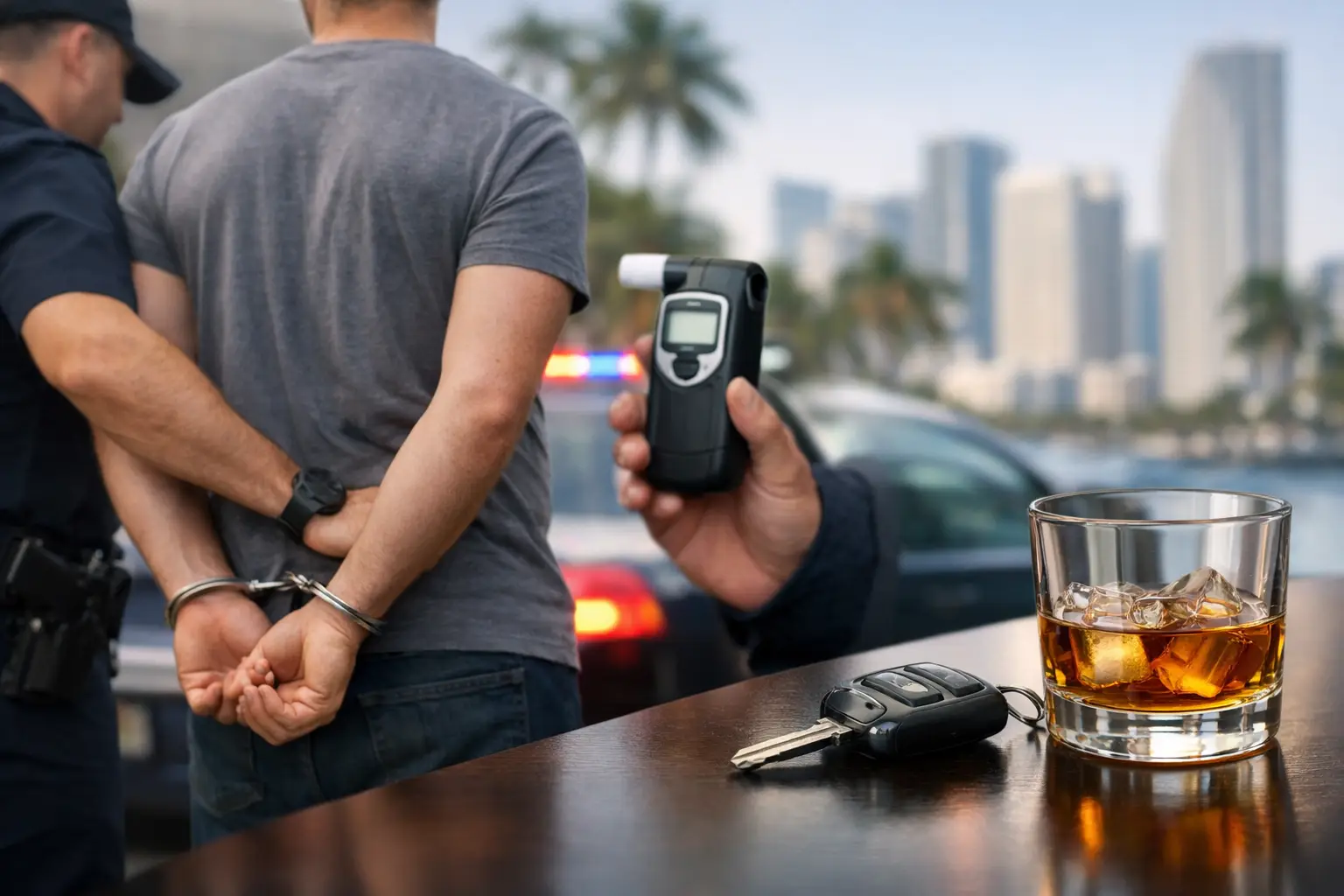
A felony dui defense guide is not something anyone expects to need at 2 a.m. after an arrest, but that is exactly when the stakes become real. If you were arrested in Miami-Dade for a felony DUI, you are not dealing with a routine traffic case. Your license, job, professional reputation, criminal record, and freedom may all be on the line at once.
That is why the first hours matter. A felony DUI charge can trigger fast-moving deadlines, police reports that shape the narrative early, and evidence issues that need to be challenged before they harden into the prosecution’s version of events. Panic is natural. Waiting is dangerous.
What makes a DUI a felony in Florida?
Not every DUI is charged as a felony. In Florida, a DUI can cross that line when the allegations involve serious bodily injury, death, or a qualifying prior record. A third DUI within 10 years can be charged as a third-degree felony. A fourth or subsequent DUI may also be charged as a felony even without a 10-year lookback issue. DUI with serious bodily injury is typically a third-degree felony, while DUI manslaughter carries dramatically higher exposure.
That distinction matters because felony court is different from misdemeanor court in both risk and strategy. You may be facing state prison exposure instead of county jail, longer license revocation periods, felony probation, vehicle impoundment, ignition interlock requirements, major insurance consequences, and a permanent criminal record that follows you long after the case ends.
For many people, the hidden cost is just as serious as the formal penalty. A felony can disrupt a professional license, security clearance, immigration status, child custody position, and future employment. That is why the defense has to focus on both the courtroom threat and the collateral damage.
The first 72 hours after a felony DUI arrest
The period right after arrest is where strong cases begin. If you were released from jail, it may feel like the emergency is over. It is not. The state is building its case immediately, and you need a defense strategy before that momentum builds.
Start by protecting the facts. Do not explain the incident to friends, coworkers, or on social media. Do not assume the police report is accurate. In many felony DUI cases, the report includes early conclusions about impairment, causation, injury severity, field sobriety performance, or refusal that may be incomplete or simply wrong.
Then focus on your driving privilege. In many DUI arrests, the clock starts running on a very short deadline to challenge the administrative license suspension. Missing that window can cost you leverage and leave you scrambling for basic transportation. A strong defense does not treat the criminal case and the license issue as separate worlds. They often affect each other.
You also need to preserve evidence fast. Surveillance footage can disappear. Witness memories fade. Vehicle damage can be interpreted the wrong way if it is not documented. Medical records can cut in more than one direction depending on what they actually show. Early investigation is not optional in a felony case.
How a felony DUI defense guide applies to real cases
No serious lawyer should promise the same defense in every case because felony DUI cases turn on details. Still, the strongest defenses often begin in a few predictable places: the stop, the arrest, the testing, and causation.
Was the traffic stop legal?
Police need a lawful basis to stop your vehicle unless the facts fit a recognized exception. If the stop was unsupported, evidence gathered afterward may be vulnerable to suppression. That can weaken the state’s case fast, especially where the prosecution is relying heavily on officer observations.
Was the arrest based on actual probable cause?
An officer’s opinion is not the same as proof. Bloodshot eyes, odor of alcohol, nervousness, poor balance, and confused answers can all be explained in other ways, especially after a crash, a late-night stop, fatigue, injury, medication use, or panic. In felony DUI cases, the consequences are too high to accept boilerplate impairment claims at face value.
Were field sobriety exercises reliable?
Field exercises are often presented as objective, but they are highly vulnerable to context. Weather, lighting, footwear, road surface, age, injury, anxiety, and medical conditions can all affect performance. If the officer gave poor instructions or scored the exercises aggressively, that matters.
Was the breath or blood evidence handled correctly?
Chemical testing is not immune from challenge. Breath machines must be maintained properly. Officers must follow required procedures. Blood draws raise chain-of-custody issues, lab handling questions, and timing problems. If alcohol levels are being used to infer impairment at an earlier point in time, the state may be making assumptions that do not hold up under scrutiny.
Can the state actually prove causation and injury?
In DUI with serious bodily injury and DUI manslaughter cases, the prosecution must prove more than alcohol consumption. It must connect impairment to the alleged harm in a legally sufficient way. That sounds straightforward until you examine speed, road conditions, visibility, actions of other drivers, mechanical issues, and the actual medical evidence. Sometimes the central fight is not intoxication alone. It is whether the state can prove your conduct legally caused the outcome it is charging.
Why prior convictions change the fight
If your felony exposure is based on prior DUI convictions, your lawyer needs to examine those priors carefully. Dates matter. Jurisdiction matters. The wording of prior judgments matters. Whether a prior qualifies under Florida law is not always as simple as the state suggests.
This is where a record-based felony DUI case can open strategic opportunities. If a prior conviction is unusable or outside the relevant period, the prosecution’s charging position may weaken. That does not guarantee a dismissal or reduction, but it can significantly change risk and negotiation leverage.
The prosecution is not just proving intoxication
People often think a DUI case rises and falls on the breath number. In felony cases, that is usually too narrow. Prosecutors also build around officer testimony, witness statements, crash reconstruction, body camera footage, 911 calls, medical records, and your own statements. A damaging case can form from small pieces that look stronger together than they do separately.
That is why the defense has to be aggressive and organized. It is not enough to argue that you were not drunk. The better question is whether the state can prove every required element beyond a reasonable doubt using reliable, lawfully obtained evidence.
What strong defense work looks like early
A serious felony DUI defense starts with speed and precision. The lawyer should obtain and review the arrest paperwork, video, dispatch records, testing records, witness statements, and any available crash evidence as early as possible. In injury-based cases, that may also mean examining medical documentation and consulting experts where needed.
Good defense work also means pressure at the right moments. That can include filing motions to suppress, attacking weak causation theories, exposing gaps in the investigation, and forcing the prosecution to prove assumptions it would rather leave unchallenged. Some cases are resolved through negotiation. Others need courtroom litigation. The correct path depends on the evidence, the judge, the prosecutor, your record, and the real trial risk.
It also depends on your life outside court. A nurse, teacher, commercial driver, business owner, or parent may face very different pressure points from the same charge. The legal strategy should reflect that. Protecting your future is not a slogan in a felony DUI case. It is the job.
What you should do right now
If you are searching for a felony DUI defense guide, you are already in the danger zone where hesitation costs options. Write down everything you remember while it is still fresh, including where you were, what you ate or drank, what medications you took, when the stop happened, what the officer said, and whether any witnesses were present. Save receipts, rideshare records, photos, and text messages if they help establish your timeline.
Then get legal help immediately from a defense team that treats felony DUI as a high-stakes emergency, not a paperwork problem. In Miami-Dade, local court practice, prosecutor habits, and timing can matter more than people realize. George Law approaches these cases with the urgency they demand because early action can mean better evidence, stronger motions, and more room to fight.
A felony DUI charge is serious, but it is still a charge. The state must prove it. Your job now is simple – act fast, protect the facts, and put a real defense between you and consequences that can change your life.