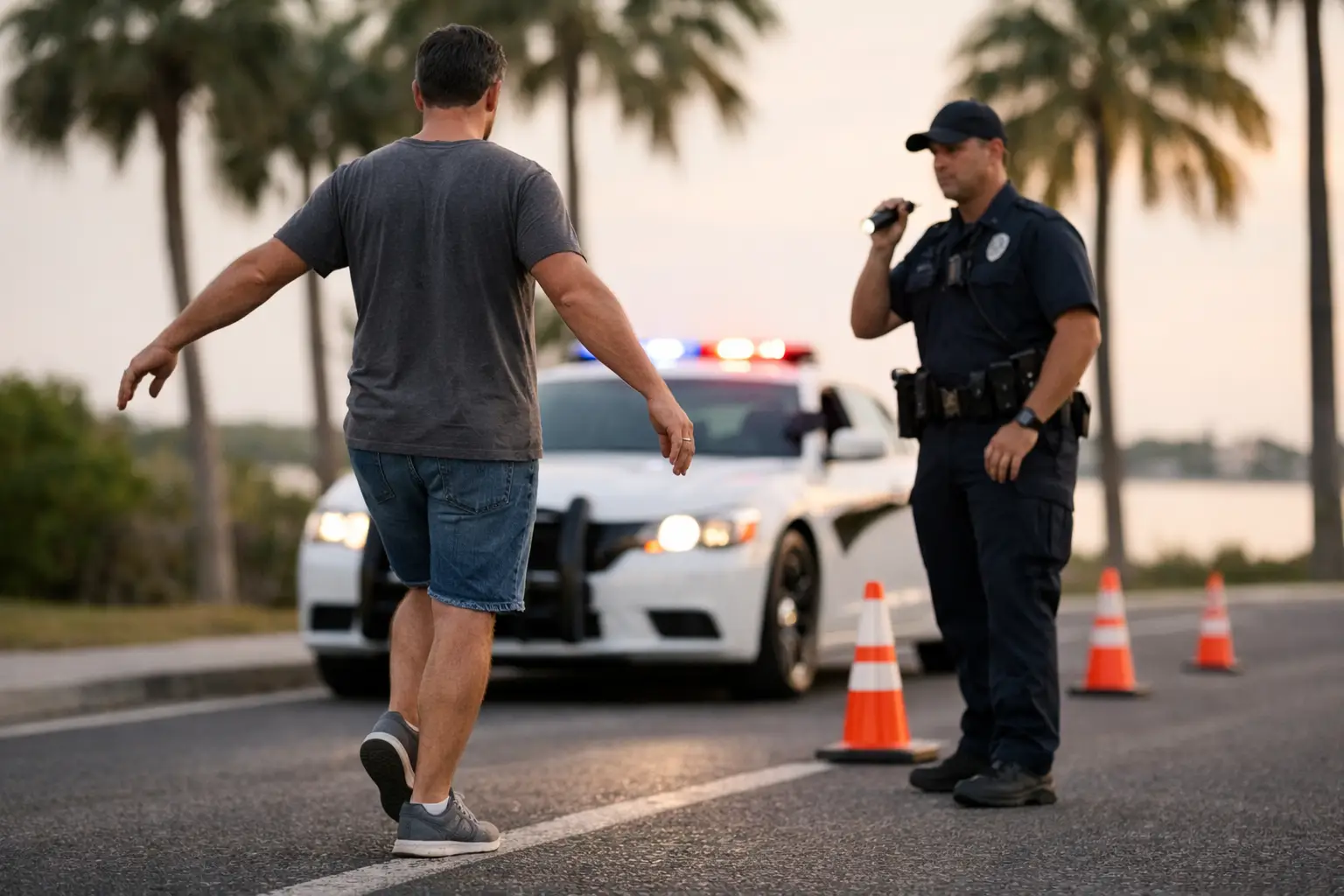
Blue lights in the mirror. A late-night stop in Miami. Then the question that puts most drivers on edge: are field sobriety tests required in Florida? The short answer is no. In most Florida DUI stops, you are not legally required to perform roadside field sobriety exercises, and refusing them is not the same as refusing a lawful breath, blood, or urine test under implied consent.
That said, the real answer is more strategic than simple. What you do at the roadside can shape the officer’s report, the evidence the prosecutor tries to use against you, and the defense options available later. If you were arrested in Miami-Dade, this is not the moment for guesswork.
Are Field Sobriety Tests Required in Florida for DUI Stops?
No. Field sobriety tests are generally voluntary in Florida. Officers often ask drivers to step out and perform exercises such as the walk-and-turn, one-leg stand, or horizontal gaze nystagmus test. They may present the request in a way that sounds mandatory, but these roadside exercises are typically not required by law.
This is where many people get trapped. They want to appear cooperative, so they agree. Then normal stress, poor balance, fatigue, age, old injuries, uneven pavement, bad weather, dress shoes, or nervousness get interpreted as signs of impairment. What feels like a chance to clear things up can quickly become evidence against you.
Refusing field sobriety exercises does not trigger the same automatic license suspension that can follow refusal of a lawful breath test after arrest. Those are different parts of a DUI case, and confusing them can be costly.
What Counts as a Field Sobriety Test?
When people think of field sobriety tests, they usually picture balancing on one leg on the side of the road. But roadside DUI investigations often involve more than that. An officer may ask you to follow a pen with your eyes, walk heel-to-toe, stand on one foot, recite part of the alphabet, or count in a specific pattern.
Some of these are standardized exercises. Others are informal tasks the officer uses to build probable cause. Either way, the officer is observing how you speak, whether you sway, whether you seem confused, and how well you follow directions.
That matters because these exercises are highly subjective. The officer is not scoring you in a lab. The officer is building a case in real time.
Why Drivers Fail Even When They Are Not Impaired
Roadside exercises are not clean science. They are performed under pressure, usually at night, often with traffic passing by and an officer watching every movement. Plenty of sober people struggle under those conditions.
A bad knee, back pain, inner ear issues, anxiety, exhaustion, and even weight or footwear can affect performance. So can language barriers and medical conditions. In South Florida, heat, humidity, rain, and uneven roadside surfaces can make a bad situation worse.
That is why these tests are often fertile ground for defense challenges. If the officer gave unclear instructions, rushed the test, ignored physical limitations, or chose a poor location, the reliability of the results becomes a serious issue.
If You Refuse, Can the Officer Still Arrest You?
Yes. Refusing roadside exercises does not guarantee you will avoid arrest. If the officer believes there is enough other evidence of impairment, an arrest can still happen. The officer may rely on driving pattern, odor of alcohol, bloodshot eyes, slurred speech, admissions about drinking, and general observations during the stop.
This is the trade-off. Taking the tests can hand the officer more evidence. Refusing them may not stop the arrest, but it can deny the state one of the most commonly used pieces of DUI evidence.
Every case turns on its own facts. In some stops, the officer already planned to arrest. In others, the roadside interaction becomes the key turning point. That is why what seemed like a small decision on the shoulder of the road can have major consequences later.
Field Sobriety Tests vs. Breath Test Refusal in Florida
This distinction is critical. Field sobriety exercises are usually voluntary. A post-arrest breath test is a different matter.
Under Florida’s implied consent law, a driver who is lawfully arrested for DUI can face an administrative license suspension for refusing a lawful breath, blood, or urine test. For many drivers, that is where panic sets in. They assume every test requested by police carries the same legal consequences. It does not.
If you refused roadside exercises, that is not the same as a breath refusal after arrest. If you refused a breath test at the station or another approved testing location after a lawful DUI arrest, your license and your defense strategy may be affected differently.
The timeline also matters. DMV deadlines can move fast, and waiting too long can cost you options.
How Prosecutors Use Field Sobriety Evidence
Prosecutors like field sobriety evidence because it is visual and persuasive, especially if body camera or dash camera footage exists. They may argue that clues on the tests showed impairment, poor coordination, divided attention problems, or inability to follow instructions.
But this evidence is far from untouchable. A strong DUI defense looks closely at whether the officer was trained properly, whether the tests were administered under acceptable conditions, whether the instructions matched the standardized method, and whether the video supports the officer’s written report.
This is where aggressive defense work matters. An officer’s conclusion is not the final word. It is a claim that can be tested.
Can Refusing Field Sobriety Tests Hurt Your Case?
It depends. Refusal may be mentioned by the officer, and prosecutors may try to frame it as consciousness of guilt. But that does not mean refusal automatically damages your defense. In many cases, refusing roadside exercises removes a layer of subjective evidence that could have made the case stronger for the state.
What matters is the total picture. If there is weak driving evidence, no crash, no clear admissions, and no reliable chemical test result, refusing field sobriety exercises may leave the prosecution with a thinner case than it wants.
On the other hand, if there is strong video evidence, an accident, or other damaging facts, refusal alone will not erase the problem. Good defense strategy is never one-size-fits-all. It depends on what the officer saw, what was recorded, what was said, and what the state can actually prove.
What You Should Do After a Florida DUI Arrest
If you were arrested, the most important move is not replaying the stop in your head or taking advice from friends. You need to act fast and protect the case immediately.
Start by writing down everything you remember while it is still fresh – where you were stopped, what the officer said, whether you were asked to perform exercises, whether you refused, what surface you were standing on, what shoes you wore, and whether any medical issue affected you. Small details can become major defense points.
Then get legal help quickly. DUI cases are time-sensitive. Video can disappear. witnesses become harder to reach. Administrative license issues move on a different track from the criminal case. Early defense work can expose errors that are much harder to fix later.
For someone facing a Miami-Dade DUI charge, that often means examining the stop itself, the basis for the investigation, the field sobriety instructions, the arrest decision, the breath testing process, and every procedural step that followed. At George Law, that kind of immediate case review is where the defense starts gaining ground.
The Bottom Line on Are Field Sobriety Tests Required in Florida
No, they are generally not required. But the better question is not just what the law allows. It is how the decision fits into the evidence the state is trying to build against you.
A roadside DUI investigation is designed to produce observations the officer can later use in court. You do not have to help build that case. If you have already been arrested, the focus now should be on challenging what happened, protecting your license, and moving fast before critical opportunities are lost.
One traffic stop does not get to define your record, your job, or your future. The right defense response, started early, can change the direction of the case.