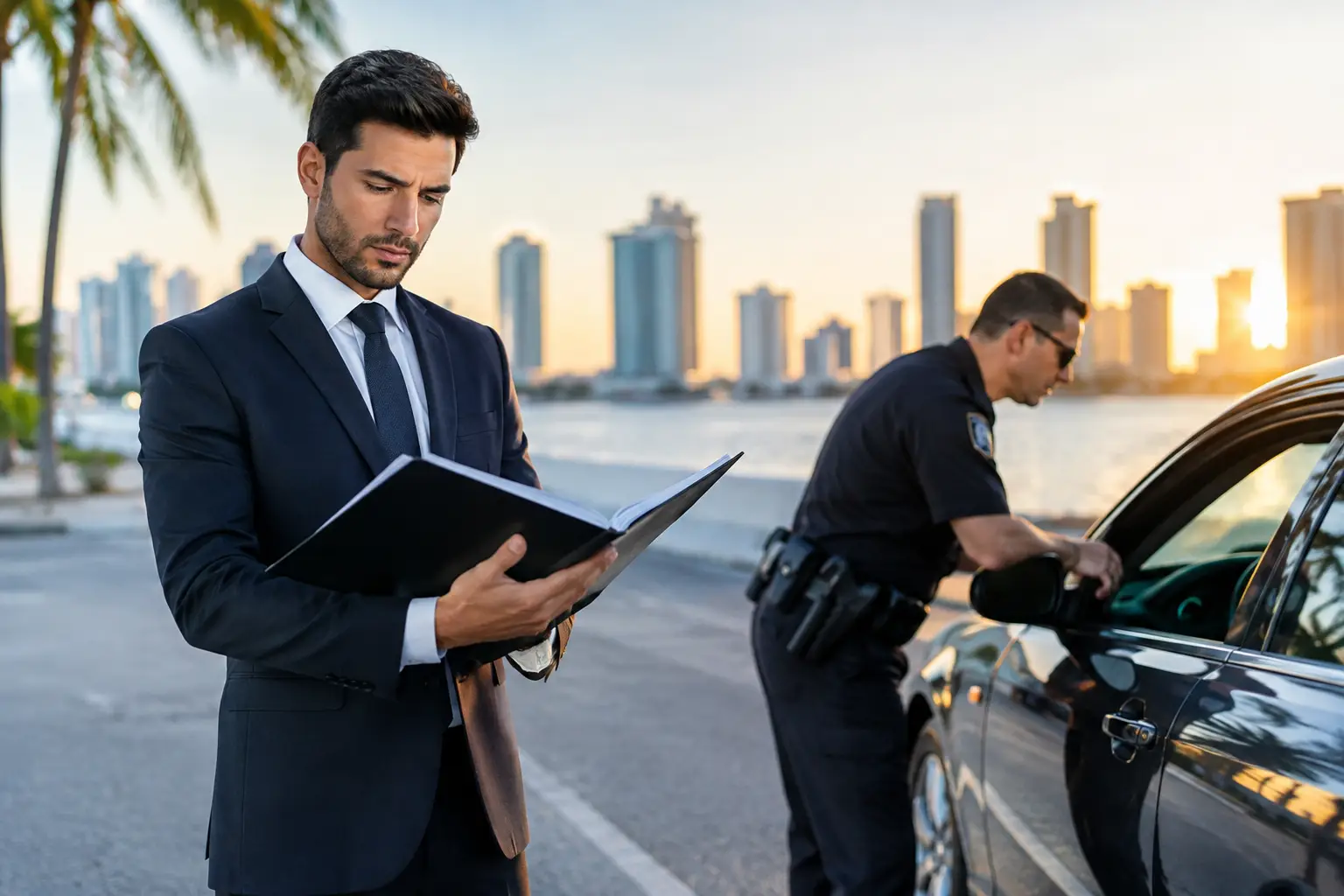
A DUI arrest can feel final when an officer has body-camera footage, a breath result, and a report that says you failed roadside exercises. It is not final. A Miami DUI suppression example shows why the evidence that appears most damaging may never reach a jury if police obtained it by violating your rights.
Suppression is not a technicality or a shortcut. It is a constitutional defense that forces the State to prove law enforcement had a lawful basis at every critical stage: the traffic stop, the detention, the field sobriety investigation, the arrest, the search, and the questioning. When that chain breaks, the consequences can be substantial.
What Suppression Means in a Miami DUI Case
A motion to suppress asks a judge to exclude evidence because it was obtained unlawfully. Depending on the facts, that evidence could include an officer’s observations, statements you made, field sobriety exercise results, breath-test results, blood-test results, or items found during a vehicle search.
The question is not simply whether you had a drink or whether an officer believed you were impaired. The question is whether the government respected the limits the Constitution places on police conduct. Prosecutors must prove their case with legally obtained evidence.
If the court grants suppression, the State may lose a key part of its case. Sometimes that creates a stronger position for dismissal or a favorable resolution. Other times, the prosecutor may still proceed with whatever admissible evidence remains. Every case turns on the evidence left standing after the hearing.
Miami DUI Suppression Example: An Unlawful Traffic Stop
Consider a common Miami-Dade scenario. A driver leaves a restaurant in Brickell late at night. An officer follows the vehicle for several blocks and reports that it briefly touched the lane marker once while avoiding a pothole. The officer initiates a traffic stop, smells alcohol, conducts roadside exercises, and makes an arrest. At the station, the driver provides a breath sample.
The State may initially view that as a routine DUI prosecution. But the defense should immediately examine the first and most important question: did the officer have reasonable suspicion to stop the vehicle?
A police officer cannot pull over a vehicle based on a hunch, the time of night, or the fact that someone left a bar or restaurant. The officer needs specific, articulable facts suggesting a traffic violation or criminal activity. A momentary lane touch, particularly where road conditions or normal driving behavior explain it, may not always justify a stop. The video matters. The road conditions matter. The precise language in the police report matters.
If the dash camera or body camera contradicts the report, or if the driving does not establish a valid basis for the stop, defense counsel can challenge the stop through a motion to suppress. If the judge finds the stop unconstitutional, evidence obtained after the stop may be excluded. That can include the officer’s claimed signs of impairment, roadside exercise performance, admissions, and chemical-test evidence.
That does not mean every lane deviation leads to suppression. Florida courts decide these issues on detailed facts. But it demonstrates the central truth: a DUI case can rise or fall before the officer ever asks you to step out of the car.
The State Must Justify Each Escalation
Even when a stop begins lawfully, police do not have unlimited authority. The officer must have a valid reason to extend the encounter into a DUI investigation. A broken taillight stop cannot become an open-ended investigation without facts supporting reasonable suspicion of impairment.
Defense review focuses on what happened minute by minute. Did the officer observe actual driving problems? Were the alleged signs of impairment consistent with fatigue, allergies, medical conditions, nervousness, or Miami heat? Did the officer prolong the stop while waiting for another unit without sufficient justification? These are not side issues. They can determine whether evidence is admissible.
Other Evidence That May Be Challenged
A suppression motion is fact-driven. There is no single defense that fits every arrest, and an aggressive review looks beyond the breath number or the officer’s conclusion.
Statements Made Without Proper Warnings
Police generally must advise a person of Miranda rights before custodial interrogation. Not every roadside conversation requires Miranda warnings. However, once a person is in custody, answers to questioning may be vulnerable if officers seek incriminating statements without first providing the required warnings.
For example, statements made in the back of a patrol car or during booking can become powerful prosecution evidence. Whether they can be suppressed depends on custody, the questions asked, whether warnings were given, and whether any waiver was voluntary. Audio and video recordings often decide the issue.
Vehicle Searches Without Legal Authority
An arrest does not automatically permit officers to search every part of a vehicle. Police may rely on consent, probable cause, a lawful inventory search, or another recognized exception to the warrant requirement. Each claimed justification must be tested.
If officers say you consented, the defense can examine whether that consent was truly voluntary and how broad it was. If they characterize the search as an inventory, the agency’s written procedures and the officer’s compliance with them may matter. An unlawful search can put physical evidence outside the State’s case.
Blood Draws and Medical Evidence
Blood evidence raises especially serious constitutional concerns. The government may need a warrant or a valid exception before obtaining a blood sample, depending on the circumstances. The defense must review the timeline, any claimed consent, the warrant application, medical records, and the chain of custody.
Blood cases are high-stakes because prosecutors may rely heavily on a reported alcohol concentration. But a number is only as reliable and admissible as the legal process used to obtain and handle the sample.
What a Suppression Hearing Actually Looks Like
A suppression hearing is not a television courtroom ambush. It is a focused evidentiary proceeding before a judge, usually held before trial. The defense files a motion identifying the constitutional issue and the evidence that should be excluded. The prosecutor responds, and witnesses may testify.
The arresting officer may be questioned in detail about the stop, instructions given during roadside exercises, the timing of the arrest, and the handling of any test. Video is compared against memory and report language. Dispatch records, breath-test documents, warrants, and agency policies can expose inconsistencies that are invisible from the arrest affidavit alone.
Credibility matters, but so does precision. An officer who says a driver was “weaving” must be able to explain what that means and show it on video. An officer who claims consent must establish how it was requested and given. A vague report should not substitute for lawful proof.
Why You Must Act Quickly After a DUI Arrest
The strongest suppression issues are often discovered early, while footage, records, and witnesses can be identified and preserved. Waiting can make a defense harder. In Florida, a DUI arrest also triggers urgent driver’s license consequences, and you generally have only 10 days to request a formal review hearing or seek certain alternatives.
Do not try to explain your way out of the case through casual conversations with police, coworkers, or social media posts. Write down what you remember instead: where you were stopped, what the officer said, whether cameras were present, what you were asked to do, and whether you requested a lawyer. Those details can help your defense team locate the pressure points in the State’s case.
A DUI charge threatens more than a court date. It can put your license, job, professional reputation, insurance rates, and freedom at risk. George Law investigates the legality of the stop and every piece of evidence that followed, because the prosecution should not be allowed to build a case on evidence obtained in violation of your rights.
The most useful step you can take now is fast, confidential legal review. Preserve the timeline, protect your license deadline, and make the State prove every part of its case before you accept consequences that may not be justified.