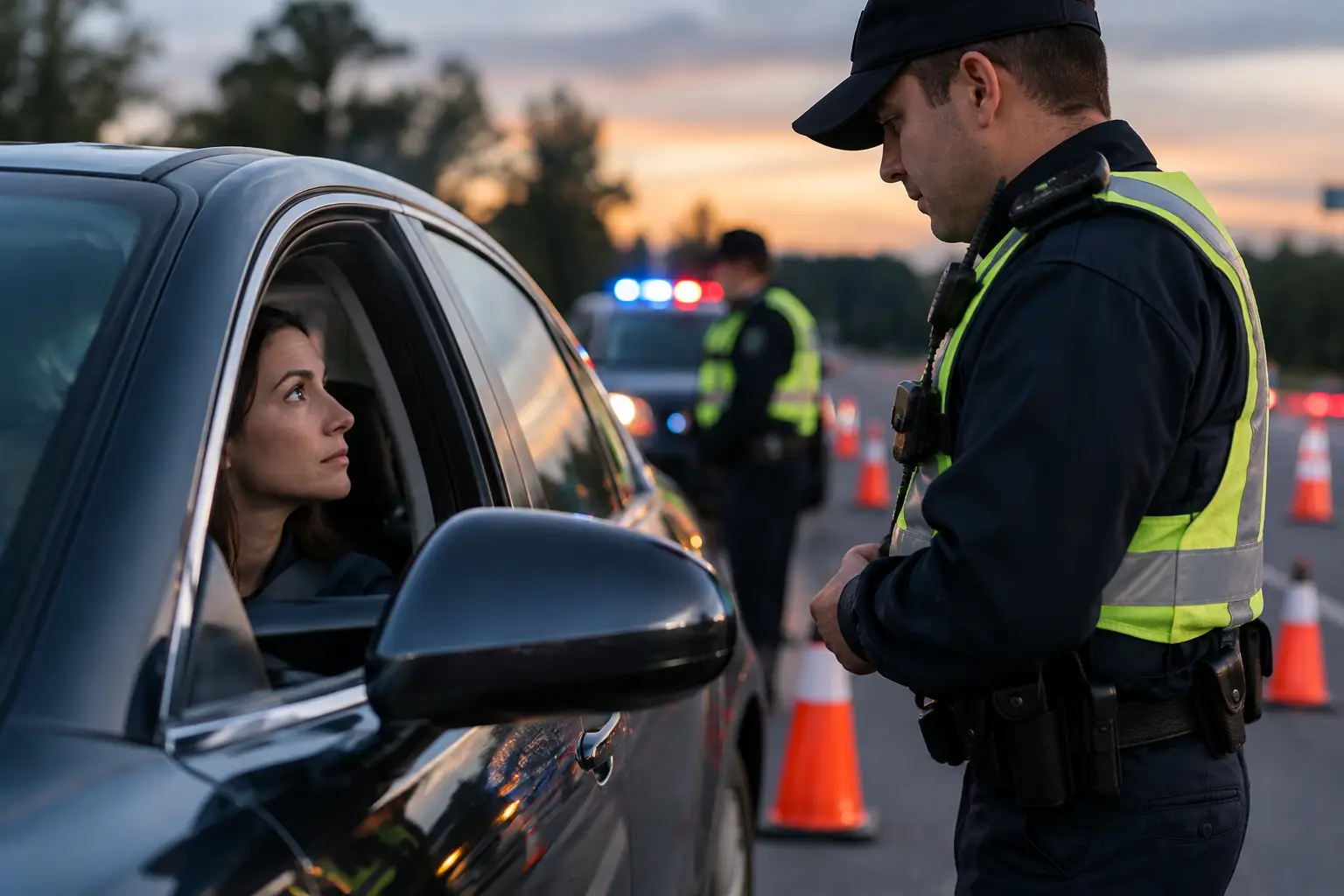
A DUI checkpoint can feel impossible to fight. Police are stopping every car, lights are flashing, and an arrest may seem like the inevitable result of a failed roadside test or breath sample. But illegal DUI checkpoints exist, and a checkpoint arrest is not automatically a valid DUI conviction. If officers ignored constitutional limits or failed to follow the checkpoint plan, the stop itself may be vulnerable to challenge.
For a Miami-Dade driver, that issue can affect far more than a night in jail. Your license, career, professional reputation, insurance rates, and freedom may be on the line. The prosecution still has the burden to prove that police obtained evidence lawfully. A strategic defense starts by examining how the checkpoint was planned, operated, and documented.
When DUI Checkpoints Become Illegal
The Fourth Amendment protects people from unreasonable searches and seizures. Stopping a vehicle is a seizure, even when an officer only speaks to a driver for a short time. Normally, police need reasonable suspicion to make a traffic stop. DUI checkpoints are a narrow exception, not a blank check for law enforcement to stop drivers however they want.
The Supreme Court has allowed sobriety checkpoints when their purpose and operation limit arbitrary police conduct. Florida courts examine whether the checkpoint used neutral procedures, gave officers adequate guidance, and imposed a reasonable intrusion on drivers. A roadblock cannot become an excuse for officers to pick and choose motorists based on a hunch, appearance, race, age, vehicle type, or other subjective factor.
That distinction matters. A checkpoint may have signs, patrol cars, and cones, yet still be unconstitutional if the operation did not follow a lawful, neutral plan.
A valid checkpoint needs real safeguards
There is no single checklist that decides every case. Courts look at the total circumstances. Still, a legally defensible DUI checkpoint typically involves advance planning by supervisory personnel, a clear public-safety purpose, and a neutral method for selecting vehicles.
For example, officers may be directed to stop every vehicle or every third vehicle. That is different from giving field officers unchecked discretion to wave through cars and stop only the drivers they find suspicious. Supervisors should establish the operational rules before the checkpoint begins, not make them up after an arrest.
Courts may also consider whether the checkpoint was visibly marked, whether it was conducted safely, how long drivers were detained, and whether the public had reasonable notice. A brief delay at a clearly identified checkpoint is easier for the state to defend than an unmarked, confusing, or overly intrusive roadblock.
Red Flags That May Point to Illegal DUI Checkpoints
An arrest at a checkpoint does not prove the checkpoint was unlawful. It does mean the government’s procedures deserve close scrutiny. Evidence that may matter includes the written operational plan, officer assignments, supervisor instructions, video footage, dispatch communications, arrest reports, and logs showing which vehicles were stopped.
Warning signs can include officers stopping cars inconsistently, no documented selection formula, poor or nonexistent signs, a checkpoint that appears designed for general crime control rather than DUI deterrence, or a detention that lasted longer than the stated procedure allowed. A defense attorney may also investigate whether officers departed from the approved plan once the operation was underway.
Police sometimes characterize a stop as a checkpoint encounter even when an officer actually selected a driver for an individualized stop. If that happened, the officer may need reasonable suspicion independent of the checkpoint. A vague claim that a driver “looked nervous” does not automatically justify every escalation.
The legal question is rarely as simple as whether alcohol was involved. The question is whether officers had the constitutional authority to stop, detain, investigate, and arrest the driver in the first place.
A Lawful Checkpoint Does Not End the Defense
Even if the checkpoint itself survives review, the DUI case may still have serious weaknesses. Officers need a legal basis to extend a brief checkpoint encounter into a DUI investigation. The odor of alcohol, slurred speech, admissions, driving behavior observed before the checkpoint, or visible signs of impairment may be relevant. But each claimed sign must be tested against the video, witness accounts, and objective facts.
Field sobriety exercises are not automatic proof of impairment. Uneven pavement, poor lighting, medical conditions, anxiety, footwear, fatigue, and confusing instructions can affect performance. At a roadside checkpoint, those conditions may be especially significant because drivers are startled, surrounded by police activity, and asked to perform under pressure.
Breath evidence is also not beyond challenge. The defense may investigate the breath machine’s maintenance records, the operator’s compliance with required procedures, the observation period before testing, and whether the test result is legally reliable. Blood testing and urine testing raise their own collection, handling, and laboratory issues.
A strong defense does not rely on one argument. It examines every stage: the checkpoint setup, the initial contact, the investigation, the arrest, chemical testing, and the state’s ability to preserve evidence.
What to Do After a Checkpoint DUI Arrest in Miami
Panic can cause expensive mistakes. You do not need to explain the case to coworkers, post about it online, or try to argue the facts with police after an arrest. Preserve what you can remember while the details are fresh, including the location, time, weather, traffic pattern, signs, what officers said, and whether other vehicles were waved through.
Do not assume that refusing to discuss the incident means doing nothing. Florida DUI cases move quickly. After a DUI arrest, you generally have only 10 days to request a formal review hearing related to your driver’s license suspension. Missing that deadline can limit your options and place additional pressure on your work and family life.
You should also protect potential evidence immediately. Checkpoint video may be overwritten. Body-worn camera footage, dash camera recordings, 911 or dispatch records, and written checkpoint plans can become harder to obtain with time. Early legal action puts the defense in position to demand, review, and challenge the evidence before the state’s narrative hardens.
How a Defense Attorney Challenges a Checkpoint Stop
A serious checkpoint defense is an evidence investigation, not a guess. Counsel can seek the agency’s checkpoint authorization, determine who created the plan, identify the neutral stopping criteria, and compare those criteria with what officers actually did. If officers deviated from the plan, that inconsistency may become central to a motion to suppress.
A motion to suppress asks the court to exclude evidence obtained through an unconstitutional stop, detention, search, or arrest. If the court finds the checkpoint illegal, the state may lose breath results, officer observations, field sobriety evidence, statements, and other evidence that flowed from the stop. In some cases, that can substantially weaken the prosecution or lead to dismissal. In others, the state may argue that separate lawful grounds existed. The facts control the outcome.
This is why a quick review of the arrest report is not enough. The most valuable evidence may be missing from the report: the supervisor’s instructions, the selection pattern, a gap in video, or the difference between what an officer wrote and what the footage shows.
George Law approaches Miami DUI cases with that level of pressure and precision. A checkpoint arrest should be investigated aggressively because the consequences are too serious to accept the police version without a fight.
Do Not Treat a Checkpoint Arrest as a Guaranteed Conviction
The state may call the operation a DUI checkpoint. That label does not settle whether it was lawful, whether your detention was justified, or whether the chemical evidence can be used against you. Every stage must withstand scrutiny.
If you were arrested at a Miami-Dade roadblock, act while records and video can still be preserved. The right defense may begin with one direct question: did police have the legal right to stop you at all?