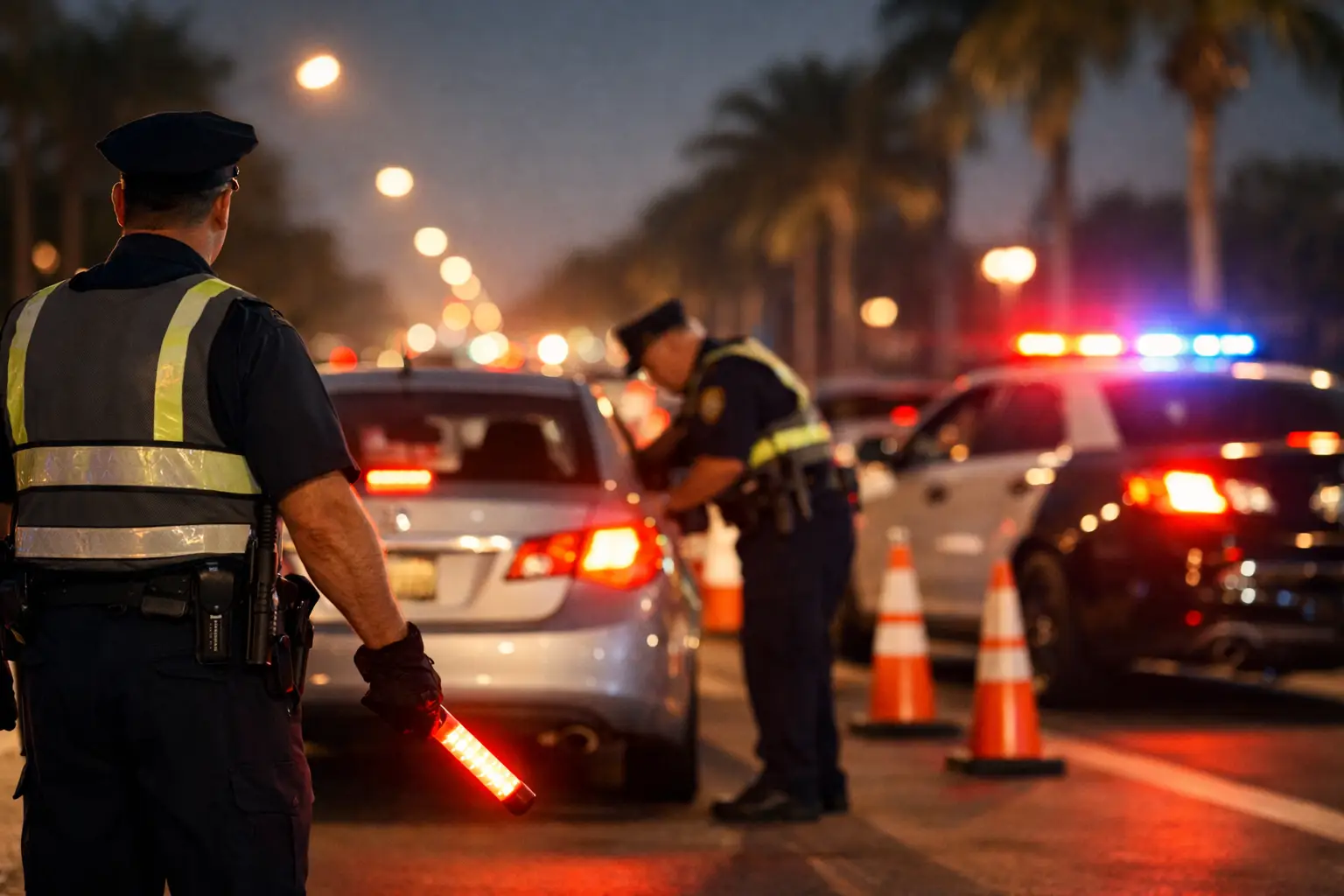
A line of police cars, cones, flashing lights, and an officer directing every driver to stop can feel like there is no room to question what is happening. But dui checkpoint legality florida is not a blank check for police. Roadside DUI checkpoints can be lawful in Florida, yet they must be planned and operated within constitutional limits. When officers cut corners, target drivers arbitrarily, or extend a stop without justification, the evidence they collect may be vulnerable to challenge.
If you were arrested after a Miami-Dade checkpoint stop, do not assume the arrest is airtight because it happened at a highly visible police operation. The checkpoint itself, the officer’s observations, field sobriety exercises, breath testing, and the length of your detention all deserve a hard, strategic review.
DUI Checkpoint Legality in Florida Depends on the Plan
Florida law generally permits sobriety checkpoints, also called DUI checkpoints or roadblocks. Courts recognize that the state has a legitimate interest in detecting impaired driving and preventing serious crashes. That public-safety purpose can allow a brief stop even when an individual driver has not committed a traffic violation.
That does not mean officers can set up a checkpoint wherever they want and stop whomever they choose. A lawful checkpoint should operate under a neutral, pre-established plan rather than an individual officer’s on-the-spot discretion. For example, the plan may call for stopping every vehicle, every third vehicle, or another predictable sequence if traffic becomes too heavy.
The details matter. A defense investigation may examine whether the agency used written guidelines, whether supervisors approved the operation, whether officers followed the stated vehicle-selection process, and whether the location and traffic controls were reasonably safe. Visible signs, marked patrol vehicles, lighting, and uniformed officers can also affect whether the operation was conducted in a manner that reasonably alerts the public and limits fear or confusion.
A checkpoint cannot be a disguise for ordinary crime control. Police may make arrests if they lawfully discover evidence of another crime during a valid stop, but the checkpoint’s primary purpose must be roadway safety, not a general effort to search for drugs, warrants, or criminal activity.
A Brief Checkpoint Stop Has Limits
At a valid checkpoint, an officer may briefly ask for your driver’s license, registration, and proof of insurance. The officer can ask short questions related to driving, such as where you are coming from or whether you have been drinking. They can also look for observations they may later claim suggested impairment, including the smell of alcohol, slurred speech, bloodshot eyes, fumbling with documents, or an open container in plain view.
You should provide required documents and follow lawful directions. You do not have to volunteer damaging explanations or try to talk your way out of the situation. Be polite, stay calm, and avoid argumentative statements. A roadside stop is not the place to litigate constitutional rights. What you say, how you move, and how the officer describes your demeanor can all become part of the report.
The key legal question is whether police had a valid reason to keep you longer than the initial checkpoint screening. A short, uniform stop may be permitted. Pulling you aside for field sobriety exercises, a prolonged investigation, or a DUI arrest requires more. Officers need specific, articulable facts supporting reasonable suspicion that you were impaired or otherwise violating the law.
That distinction is critical. The fact that you passed through a checkpoint does not automatically justify a DUI investigation.
Can You Turn Around Before a DUI Checkpoint?
Drivers often see a checkpoint ahead and make a legal turn onto another street. Turning away by itself is not automatically illegal, and it does not automatically prove impairment. Police cannot simply punish a driver for choosing a lawful route.
Still, the surrounding facts can change the analysis. An abrupt, unsafe U-turn, a traffic violation, driving onto private property in a suspicious manner, or ignoring an officer’s direction may give police an independent reason to stop the vehicle. The prosecution may argue that your conduct showed consciousness of guilt. A defense lawyer should separate legal driving choices from actual violations and examine what officers truly observed rather than accepting a conclusory report.
Field Sobriety Tests and Breath Tests Are Not the Same
Once an officer claims signs of impairment, you may be asked to perform roadside field sobriety exercises. These are commonly presented as routine tests, but they are subjective and can be affected by poor lighting, uneven pavement, medical conditions, footwear, fatigue, nerves, and confusing instructions. Checkpoint conditions can make those problems worse. Noise, flashing lights, passing traffic, and a line of waiting vehicles are not ideal testing conditions.
Florida’s implied-consent law creates a different issue after a lawful DUI arrest. Refusing a post-arrest breath, blood, or urine test can trigger driver license consequences, and a refusal can potentially be used against you in court. The legal consequences depend on your prior history, the type of test requested, and whether the officer followed required procedures. This is not a decision to make casually, but it is also not a reason to surrender your right to challenge the arrest later.
A DUI defense does not rise or fall on one breath result or one officer’s opinion. The defense may scrutinize the basis for the extended detention, body camera footage, dash camera footage, the administration of field exercises, the implied-consent warning, breath-machine records, and the checkpoint’s operational materials.
How a DUI Defense Challenges a Checkpoint Arrest
The strongest defense is built from the evidence, not assumptions. A lawyer can request and analyze documents that are rarely handed to a driver at the roadside. That may include the checkpoint plan, supervisor instructions, staffing assignments, vehicle-stop logs, radio communications, video, and the officers’ reports.
A careful review may reveal that officers failed to follow the neutral stopping sequence. Perhaps they began selecting vehicles based on appearance, made unexplained exceptions, or changed the process without a documented safety reason. It may show that the operation had inadequate supervisory control or that the stated purpose did not match how officers actually used the checkpoint.
Even if the checkpoint was properly established, the individual DUI investigation can still be challenged. The officer may have lacked reasonable suspicion to order you out of the vehicle or direct you into field sobriety exercises. Video may contradict claims that you were unsteady, confused, or unable to follow directions. Breath-test evidence may be vulnerable if testing procedures, observation requirements, or machine maintenance records are deficient.
These challenges can lead to suppression of evidence, stronger negotiation leverage, reduced charges, or dismissal in the right case. No attorney can honestly promise a particular result. But accepting the officer’s version without investigation is not a defense strategy.
The License Deadline After a Florida DUI Arrest
After many Florida DUI arrests, the driver’s license case moves on a separate and immediate track from the criminal charge. You may have only 10 days from the date of arrest to request a formal review hearing and protect your opportunity to challenge the administrative suspension. Missing that window can sharply limit your options.
That deadline applies whether the arrest began at a checkpoint, a traffic stop, or an accident investigation. Waiting for the first court date is a costly mistake. The early days after arrest are when video is most likely to be preserved, witnesses can be identified, and the checkpoint operation can be examined before key details disappear.
If a checkpoint arrest put your license, job, professional reputation, or freedom at risk, move quickly. George Law can evaluate the stop, attack weak evidence, and build a defense focused on protecting what this charge threatens most: your future.